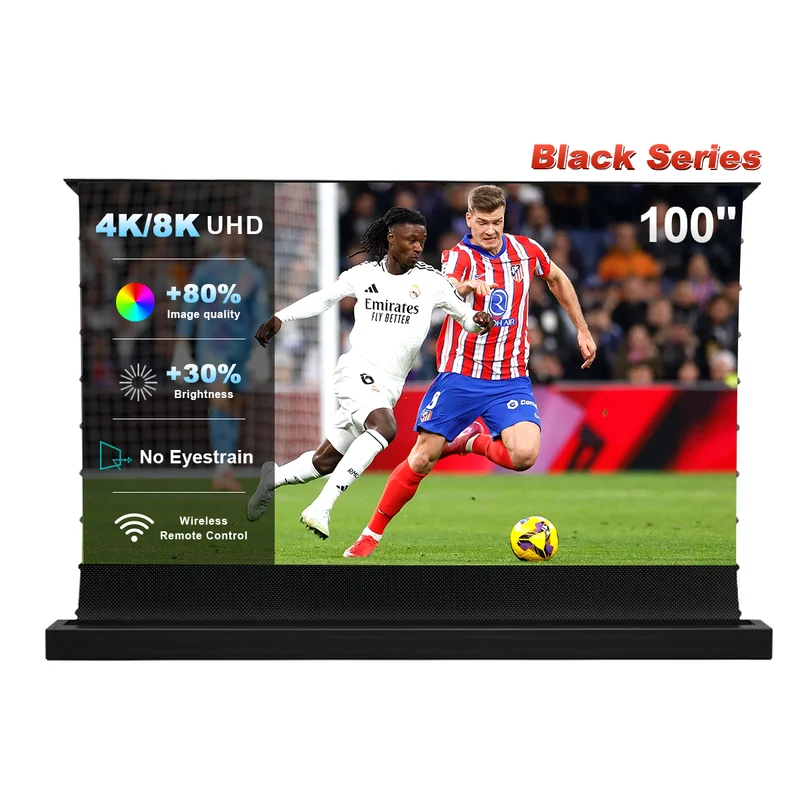
What the Black Series is
The NothingProjector Black Series is a motorized floor-rising ambient-light-rejecting screen built for ultra-short-throw projectors. Instead of living permanently on the wall, the screen rolls into a floor-level case. That makes it attractive in living rooms where a fixed projection surface would dominate the space.
This is a research-based review, not a claim of first-hand ownership. Our factual product statements come from the current NothingProjector product page, current competitor specifications, and independent/community review material checked in September 2026.
Key listed specifications
| Specification | NothingProjector listing | Why it matters |
|---|---|---|
| Projector type | Ultra-short throw only | UST ALR surfaces are directional; using the wrong throw geometry can severely reduce image quality. |
| Gain | 0.6 | Lower gain generally sacrifices some brightness to improve control of stray light and black-floor perception. |
| Viewing angle | 170° | A broad listed viewing cone is useful for wider seating arrangements. |
| Ambient-light rejection | 95% merchant claim | Useful as a comparative claim, but not a promise that daylight becomes irrelevant. |
| Sizes | 84–130″ | Enough range to cover apartments through large living-room setups. |
| Control | RF remote, trigger, voice/app options | Important for routines where the screen rises when the projector turns on. |
| Screen material | Premium HBST PET / ST Carbon Black coating | The optical surface is designed around UST light arriving steeply from below. |
What the specs mean in a real room
1. The biggest benefit is contrast retention in non-dedicated rooms
A conventional white wall or matte-white screen scatters projected light broadly. A UST ALR surface uses directional optical structure to return more projector light toward viewers while rejecting more light arriving from other directions, especially overhead. The visual benefit is usually most obvious in black levels and perceived contrast, not simply “brightness.”
2. A floor-rising design changes the room, not just the picture
For many buyers, the real decision is architectural. A 100–130 inch fixed frame is a large permanent object. A floor-rising screen can disappear into a low console or sit in front of windows, artwork or a multi-use wall. That flexibility is why this product category exists.
3. The 0.6-gain surface is a deliberate trade-off
A 0.6 gain rating is lower than a typical 1.0 matte-white reference surface. That can reduce luminance, but in a UST/ALR system the goal is often higher usable contrast in a lit room rather than maximum raw brightness. Pair the screen with a sufficiently bright UST projector and calibrate for the room.
4. Setup precision matters
UST projectors are unusually sensitive to tiny changes in distance, height and level. If the chassis or projector moves, the image can miss the screen edges. The merchant also warns against casually changing the factory-set maximum screen height because poor adjustment can create waves or distortion.
Trade-offs to consider before buying
- UST-only compatibility: this is not a general-purpose screen for long-throw projectors.
- Heavy, long chassis: the merchant lists packaged weights around 30 kg for 100″ and 33 kg for 120″, so delivery path and furniture support deserve attention.
- More moving parts than a fixed frame: motors, tensioning and controls add convenience but also complexity.
- ALR cannot fully defeat uncontrolled daylight: blinds and sensible light management still improve results.
- Price and availability move: use the live merchant page rather than relying on a static article price.
Who should buy it?
Best fit: a living-room UST owner who values a clean space, wants a large screen that can retract, and watches with some ambient light. The product is particularly compelling when a fixed-frame screen would block a window, artwork or shared wall.
Skip it: if you use standard throw, have a dedicated dark theater where a fixed frame is easy to leave in place, or want the simplest possible screen with no motorized mechanism.
Want to see the current size, housing and PRO/PRO A options?
Use the merchant page for live pricing, availability, shipping notes and the latest configuration choices.
Check Current Black Series OptionsAffiliate link.
Editorial comparison context
The closest direct competitor is Vividstorm’s S PRO floor-rising UST ALR line. Both currently list 0.6 gain and 170° viewing angles, with app/voice control and floor-rising formats. That makes the decision less about one spec and more about size availability, casing, control preferences, support, price, and room fit. Our dedicated NothingProjector vs Vividstorm comparison handles that decision separately.
FAQ
Is the Black Series only for UST projectors?
Yes. NothingProjector currently labels this screen for ultra-short-throw projectors only.
What sizes are listed?
Our September 2026 research found 84, 92, 100, 110, 120 and 130-inch variants on the product page.
Can it work in daylight?
ALR technology can improve contrast in ambient light, but room lighting still matters. Think “more resilient in light,” not “immune to daylight.”
Does it need wall mounting?
The appeal of floor-rising designs is that the screen rises from its own case rather than requiring a permanent fixed frame on the wall.