How ALR screens reject ambient light
ALR screens use optical layers, microstructures or directional coatings. For UST projectors, the screen is usually engineered for light arriving steeply from below. Light arriving from overhead is absorbed or reflected away from the audience more aggressively than the projector light.
This is why orientation matters. Turn some UST ALR materials upside down and you can reject the projector itself.
ALR vs matte white
| Characteristic | UST ALR / CLR | Matte white |
|---|---|---|
| Ambient-light resilience | Usually stronger when light comes from rejected directions | Low; scatters room and projector light broadly |
| Projector compatibility | Often specific to throw direction | Broad compatibility |
| Gain | Frequently below 1.0 for UST CLR surfaces | Often around 1.0, varies by material |
| Viewing behavior | Directional; depends on material | Typically broad and uniform |
| Best room | Mixed-use living room with controllable but present light | Dark or well-controlled room |
What “95% ALR” does and does not mean
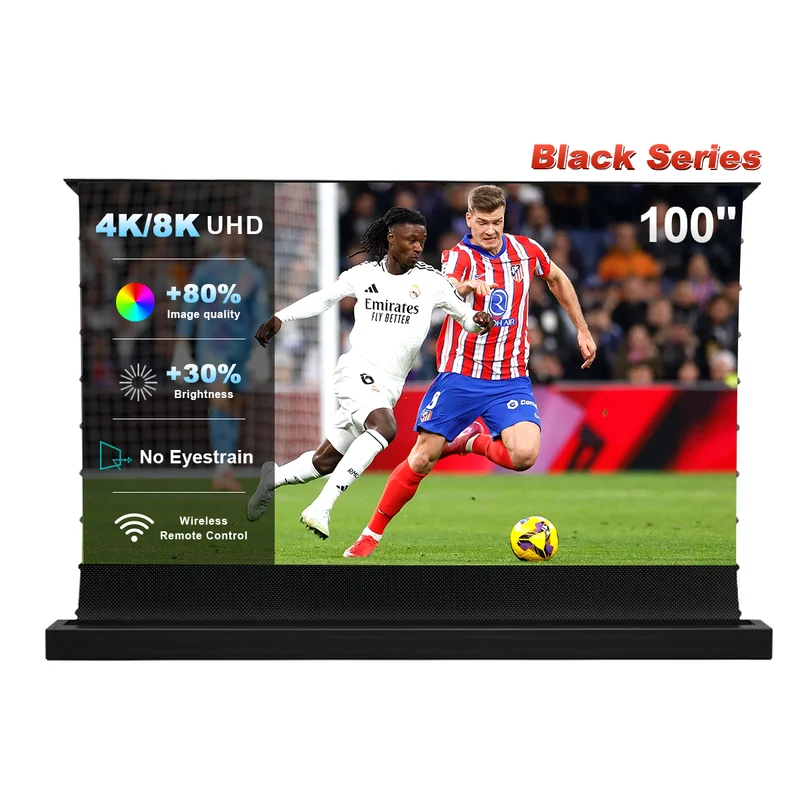
The NothingProjector Black Series is marketed with a 95% ambient-light-rejection claim. Treat that as a product specification supplied by the merchant, not a guarantee that 95% of every possible light source disappears. Measurement method, direction and wavelength matter.
In practical terms, focus on what you can control: blinds, light placement, wall color, projector brightness and calibration.
Gain and perceived contrast
The Black Series lists 0.6 gain. Lower gain may sound like a downgrade if you think only in brightness terms, but ALR design is a system trade-off. By rejecting more stray light and reducing the screen’s black floor in a lit room, a lower-gain directional surface can produce an image that appears more contrasty than a brighter white screen under the same ambient conditions.
For a deeper explanation, see projector screen gain explained.
Does ALR replace light control?
No. Even a good ALR screen benefits from sensible lighting. Avoid strong light aimed directly at the screen. Use shades for windows that sit near the projector’s optical path. If you can dim lights during critical movie viewing, do it.
Why UST + ALR is a common pairing
UST projectors are marketed as living-room alternatives to large televisions, which means they often operate outside dedicated blacked-out theaters. The steep projection angle also makes it possible to build optical surfaces that distinguish projector light from overhead room light. That combination is why CLR/ALR screens are common in laser-TV setups.
Looking for a UST-specific ALR screen?
The Black Series is designed for UST projectors and currently lists a 0.6 gain, 170° viewing angle and multiple floor-rising sizes.
Check Black Series ALR Screen